
Powerful.
Recognize our economic benefits.
There are so many mediums by which we learn. Art is particularly powerful, touching our senses and moving our spirit whether through poetry, photography, graphic designs or so much more. Taste some of the samplings by which we have gained deeper insights into intercultural living.

Powerful.
Recognize our economic benefits.
Lovely


 M. Bennett
With the best of intentions, we often travel through different countries, meet persons from different backgrounds and come away after brief encounters believing that people are basically alike. Some call this the “One World” theory – the idea that language and other cultural differences are quite superficial and that basically people are the same.
But really, are we all alike? We may differ not only in the languages we speak but how we answer such basic questions as the character of human nature, the relationship of humans to nature, the importance of time in human activity, the purpose of human activity and the nature of human relationships. While all cultures address these questions, they don’t all answer them the same way.
As we grow up in our own cultures, we view the way we do things as right, natural, and possibly the only way to respond. This is the basis of what is called ethnocentrism – the tendency to view our own culture as the right, natural and only way. When we encounter another culture that is different, we then unconsciously judge that culture by our own cultural frame of reference. The very first encounter with the culturally different almost always provokes an extreme ethnocentric response of defensiveness toward people of the other culture, by criticizing or feeling superior to them.
After repeated exposure to another culture and the development of some cultural awareness, we may move on to a position where we no longer deny the existence of differences between cultures, but neither do we accept the fundamental nature of those differences. This then becomes a stage of minimization of those differences, essentially recognizing they are there but are not as important as the basic underlying similarities between people. The “One World” theory is an example of this. The similarities are sometimes viewed in terms of physical needs (such as, we all have to eat, procreate and die) or in universal transcendent terms (such as we are all God’s children, or all people want and need to realize their individual potential). While people in this stage are able to recognize and accept cultural differences, they are uncomfortable with emphasizing those differences and resolve them by minimizing their significance. But the resolution is still basically ethnocentric, in a more subtle way.
There are further potential stages of cultural sensitivity, and they almost always come only after extended immersion in another culture, along with the development of substantial cultural competence. As a result there is a major shift from ethnocentrism to ethnorelativism. Ethnorelativism is conceptually different in that it assumes that cultures can only be understood relative to themselves. There is no natural, right standard that can be applied to all cultures. This assumes that one’s own culture is no more central to reality than any other, regardless of one’s own preferences.
The move from ethnocentrism to ethnorelativism, is usually difficult, both intellectually and emotionally. If no one culture is inherently right or wrong, but just different, many people mistakenly conclude that they must necessarily approve of all aspects of all cultures. Although there is no necessity of ethically agreeing with all cultures in this stage, many people believe that is what they must do. As a result, they are often overwhelmed by this apparent dilemma, and either move on to a more developed stage of sensitivity, or fall back to some form of ethnocentrism.
On the other hand, moving to ethnorelative thinking can be liberating and exciting. We can learn to expect and look for differences, knowing that understanding those differences will help give the new culture meaning and help make sense of it. Instead of judging another cultural practice as bad, because it is different, we look for differences in behaviour and values and try to understand why they occur from the point of view of that culture. For example, Canadians tend to pride themselves on punctuality, especially in matters of business. In trying to make a business appointment in another culture, a Canadian might find that his or her business counterpart arrives late, keeps them waiting, and then allows all sorts of interruptions, other business and social events to interfere. An ethnocentric interpretation might be that the other person isn’t very businesslike, is rude, disrespectful and disorganized. An ethnorelative view might be to try to understand why those behaviors and values are present, and what they mean. It assumes that the above behavior is normal for that culture and that the person is behaving exactly as he or she should. In that culture, it may be that time is very past or future oriented, not present oriented. It may be that business and social life are constantly mixed, not separated. It may be that no disrespect whatsoever has been shown, and the other person may be behaving quite ethically, within the values of that culture.
Acceptance of these differences and trying to understand them leads to the ability to learn to adapt to them, when operating in that culture. Adaptation then becomes another developmental stage in ethnorelativism. It is more than the adage, “When in Rome, do as the Romans do,” because such behavior comes with an understanding of why it is important. As one might expect, this stage takes a considerable degree of cultural competence and the time in which to develop it.
The final stage of ethnorelative awareness is an open-ended one. It is a stage of true integration of a multicultural point of view. The person is essentially at home and competent in at least two cultures, often ones with radically different points of view on many basic aspects of life. Paradoxically, the person is also not really at home in either culture. Because they can now see their own culture from another point of view, and because they have lived life from that point of view, they can never be exactly as they were before. On the other hand, no matter how well they adapted to the host culture, they know that is not completely “them” either.
In time, and with some help interpreting their experiences, they can come to see that they now view their own culture more clearly, often appreciating it much more, while also being more critical of it. They develop a sharper concept of who they are and what they stand for. At the same time, they understand and appreciate at least one other culture that is different from theirs, and different at some fundamental levels. They have learned to appreciate those different behaviours and values as being just as right and valid for that culture as theirs are for their own culture.
People with a true multi-cultural or at least bi-cultural orientation, who have integrated those awarenesses, think not in terms of one world, but instead, of many worlds. But they are not so concerned that these differences exist. They not only tolerate differences, they appreciate them. They become part of an ongoing process of moving in and out of their own cultural context. Since they are not bound by their native cultural frame of reference at all times anymore, they are able to shift, appropriately, among points of view.
Taken from speech by Dennis White, Ph.D.
I love it when things come together. Whether it’s watching a good suspenseful movie or reading a great mystery and finally getting all the pieces of the plot in place, I love it when it comes together.
I love it when plans come together. Starting a morning with my coffee in hand and going through recipes, walking through my herb garden and rubbing my fingers through the herbs, smelling the fragrance left on my fingers, anticipating which ones I will use for the dishes I will cook.
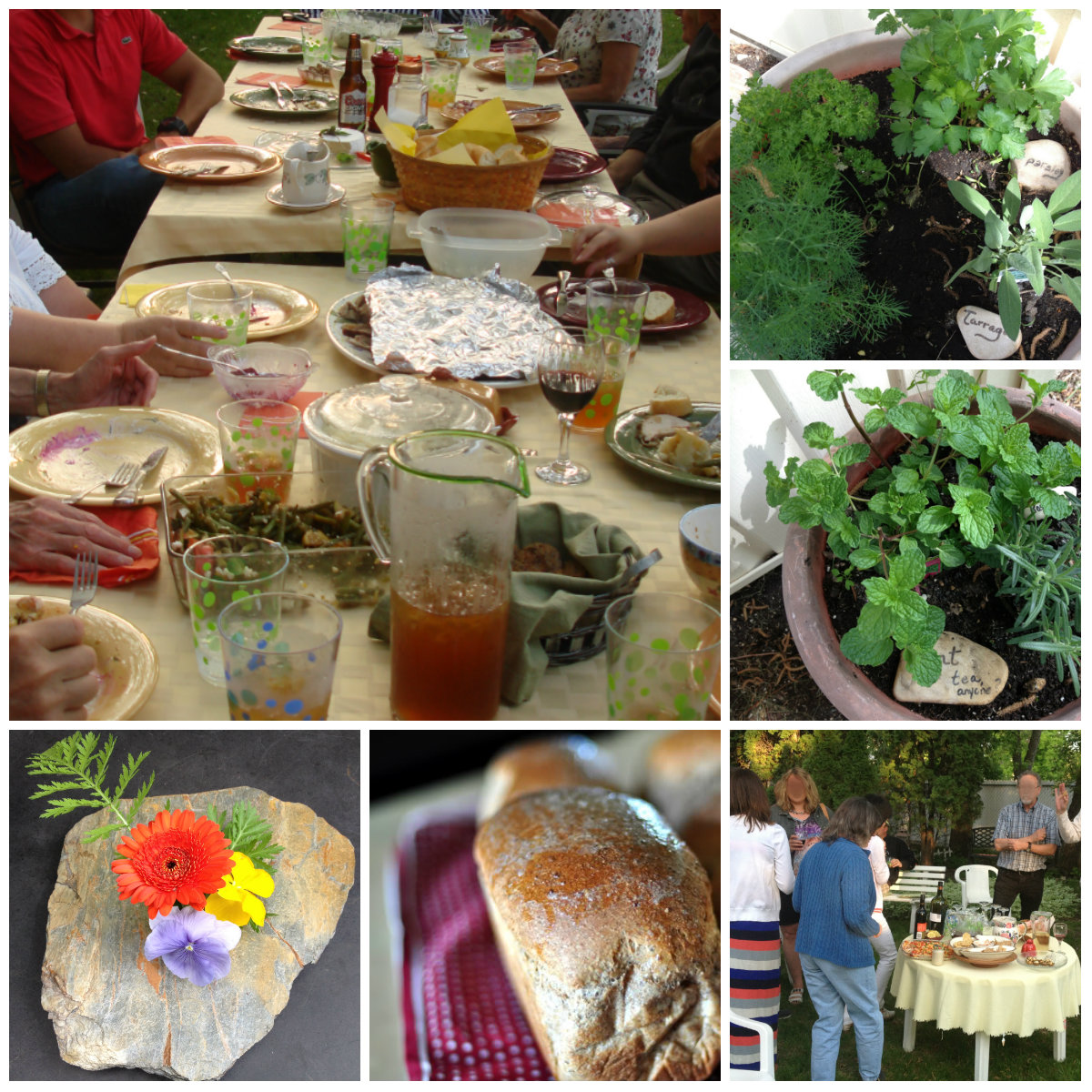 I love the messiness of kneading the bread dough by hand, and then smelling the bread as itbakes, and thinking about the hands that will break off pieces to dip into the variety of dishes knowing not everyone will choose the same ones.
I love setting the table and then cutting fresh flowers to grace the table. I love it when there is laughter at the table and the clinking of glasses and cutlery as people enjoy the food and each other’s company and it all comes together.
I love the sound of voices, rising and falling as discussions become passionate and people share their hearts. Sometimes it’s messy as the disagreement rises to the table. I love knowing who’s voice will likely rise first because of how they express their passion, knowing who will need to be coaxed into the discussion and who may choose to share their thoughts the next day privately.
That’s the beauty of loving diversity, isn’t it? The freedom to choose which foods we will eat, to express ourselves because we are accepted and appreciated, knowing effort will be made for each to understand and to be understood. I love it when things come together.
A Pilgrim’s Plea
Please don’t ask us to “reinvent” ourselves
for a changing world of work.
For we only wish to unfold,
to continue the miracle of being born.
To greet each day as the world does,
Fresh, new and ripe for living.
We long to lean towards the sun like flowers –
eager to blossom,
To move wild like waves under a silver moon-
drawn on the tide of our native longing.
We wish to belong to the world, yes.
But first and foremost, we wish to belong to ourselves.
For you cannot downsize, right size or minimize the human soul –
That place in each of us that is our true home
is totally immune to the corporate takeover,
to mergers and acquisitions,
because it’s not for sale.
Please don’t ask us to be so smitten with technology
that as we enter more deeply into the world of the virtual,
we surrender what has always come natural.
Let us not be hypnotized by the 21st century mantra “To accept change as the only constant in our lives”.
Can we not, instead, restore our faith in those things that never change?
Like the genius in the seed
to become a flower, a tree or a human being.
The faithful turning of the earth,
Or the lovely way that gravity
continues to hold us to her.
Can we not restore our faith
in the persistent beckoning of the human heart
To give and receive,
To love and be loved,
To fail with as much grace as we succeed?
As we become more firmly rooted in ourselves
may we cease to demand that the world navigate our work lives with promises of more programs,
more positions and more promotions.
May we have the maturity to see that
those in the oval office,
those in the board room,
those on the trading floor
are not prophets…
they, too, are pilgrims,
their every step remaining as much a mystery as our own.
For each of us must travel the uncharted seas of our lives, alone, yet, blessedly, together, side by side.
Trusting that inner compass of hope and courage and imagination.
Never forgetting that when you bring heart to the journey, you make it holy.
When you bring heart to the journey,
you will not lose sight of the brilliant stars in the immense night sky.
This the pilgrim’s plea at the onset of the 21st century.
To bring all that we are and all that we have
To the joy and the sorrow
The wonder and the terror
The known and the unknown
of daily living.
But, please, don’t ask us to reinvent ourselves
for yet another change in the world of work,
For we only wish to unfold,
to continue the miracle of having been born.
©Denise Bissonnette, 2000

 BridgeWorks